


So I’ve been gone a few months, and upon returning it seems everyone is freaking out even more about self-promotional listicles. I wanted to see what my own client data said about them.
Self-promotional listicles are those “best [category] software” lists everyone is writing, where a vendor names itself first and then compares its main competitors against itself. They have always been a standard SEO practice. They exploded over the last two years once people identified them as a primary citation source for LLMs.
TL;DR
I analyzed 93,968 AI answers across five B2B SaaS clients and their competitors to test the rumor that AI cites a self-promotional listicle and skips the publisher’s name.
Listicles still earned 60.9% of citations in Q3 2026, down 1.2 points from Q2.
The rumor held to an extent. 54.6% of answers that cited a vendor’s own listicle left that vendor unnamed.
However, 78 of 94 vendors got named more often with their own listicle cited, and I found zero evidence of harm in publishing self-promotional listicles.
A cited listicle still nearly tripled the share of answers that named the vendor, 45.4% against 16.3% on the same questions.
Brand size set the starting point. Nearly unknown vendors went from 0.9% to 21.5%, and dominant brands went from 74.8% to 80.0%.
The data set
I pulled everything from Scrunch across five of my B2B SaaS clients. They appear here as Client A through Client E.
1,854 tracked prompts
93,968 AI answers across Q2 and Q3 2026, with 50,044 of them in Q3
421,687 citations classified by page type
5,320 Q3 answers checked for whether the publisher of a cited listicle got named
112 vendors that publish listicles ranking themselves
One limit up front. The prompts I track lean heavily toward “best X” and “X alternatives” questions, which favors listicles from the start.
Listicles were still the top cited page type
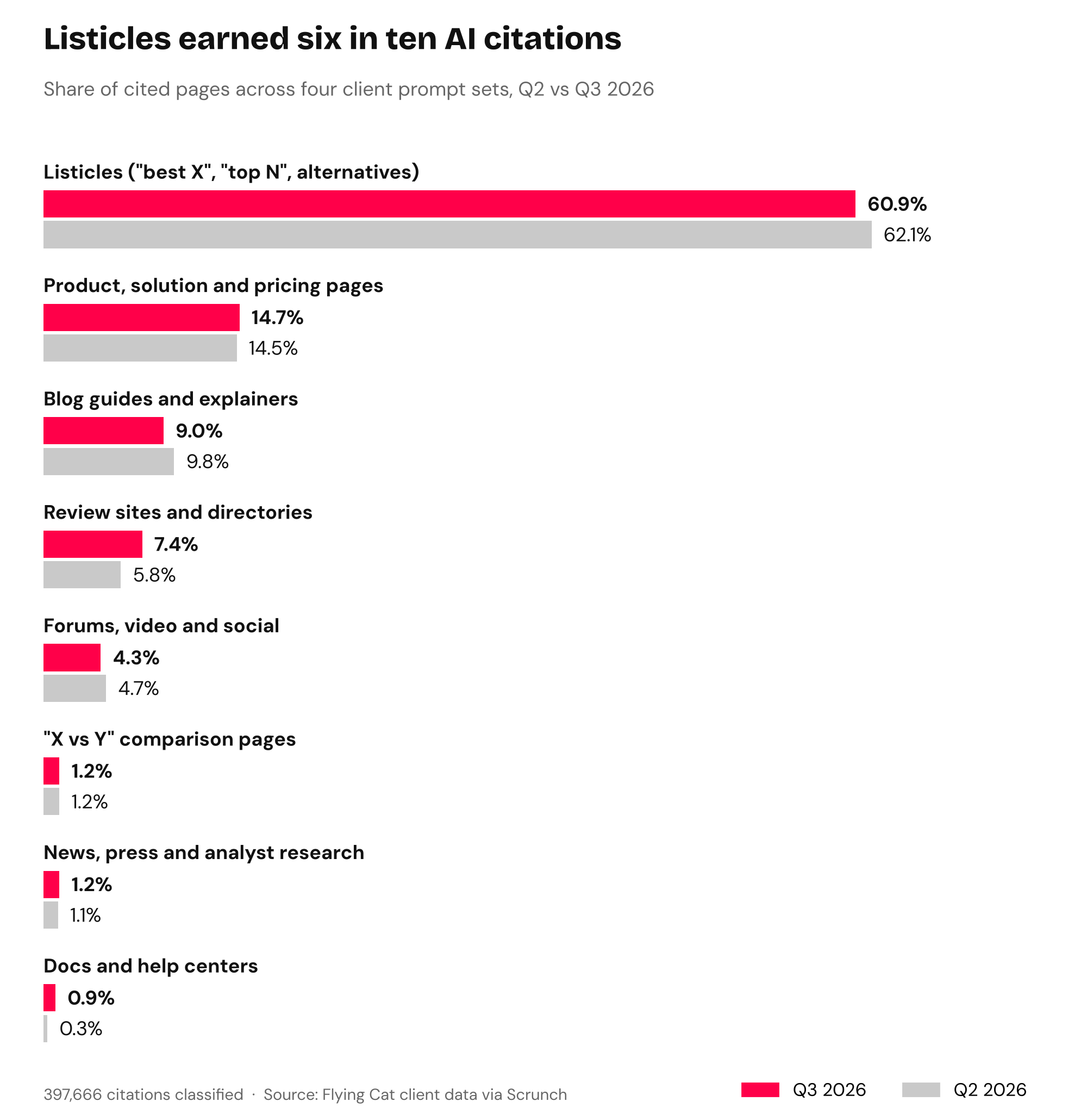
Listicles earned 60.9% of citations in Q3, down 1.2 points from 62.1% in Q2. Review sites and directories gained the largest share, from 5.8% to 7.4%. Every other page type moved by less than a point.
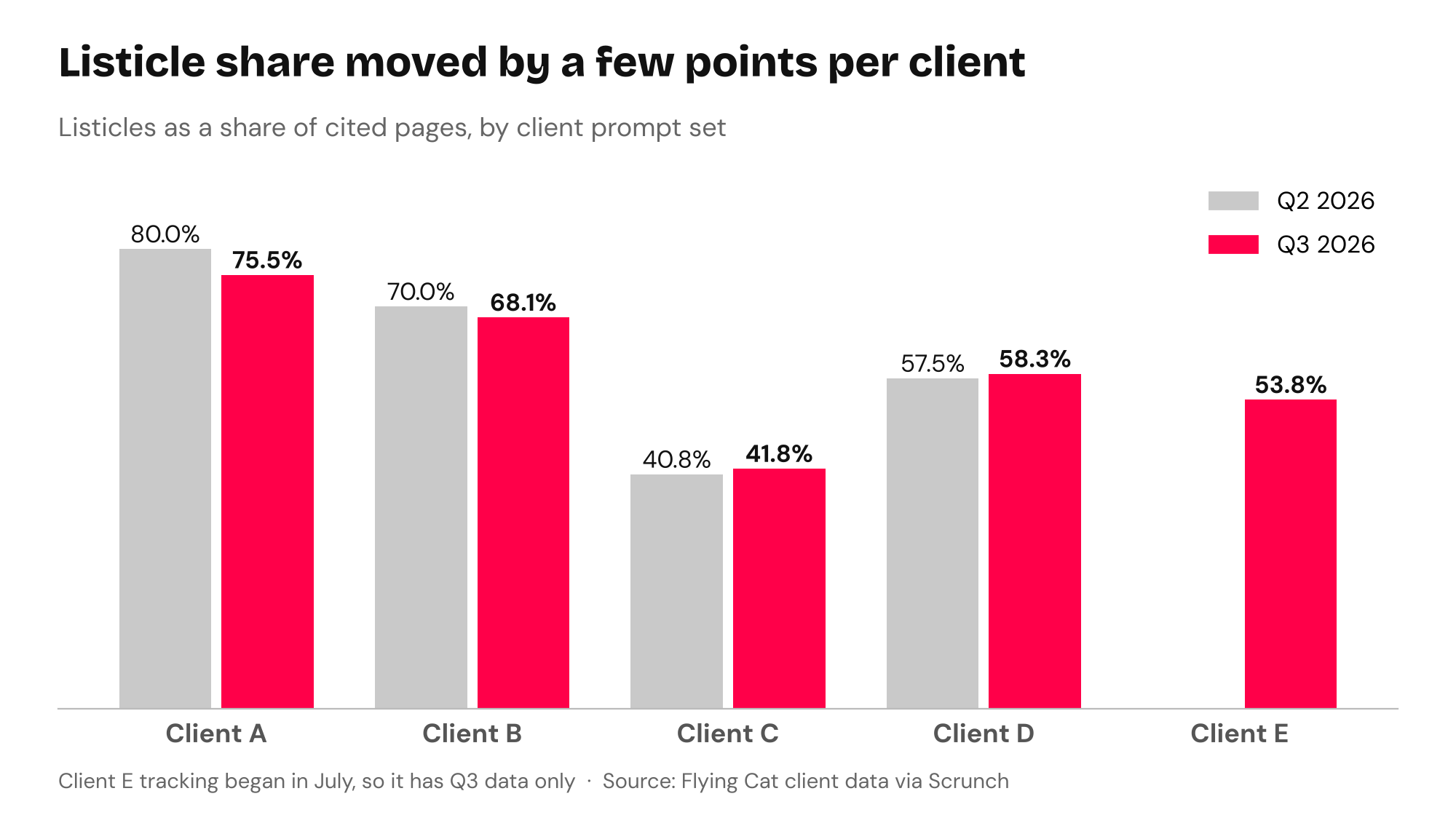
The picture varied by client. Client A went from 80.0% to 75.5% and still had the highest listicle share of the five. Client C sat at 41.8%, in a category where product pages took 31% of citations.
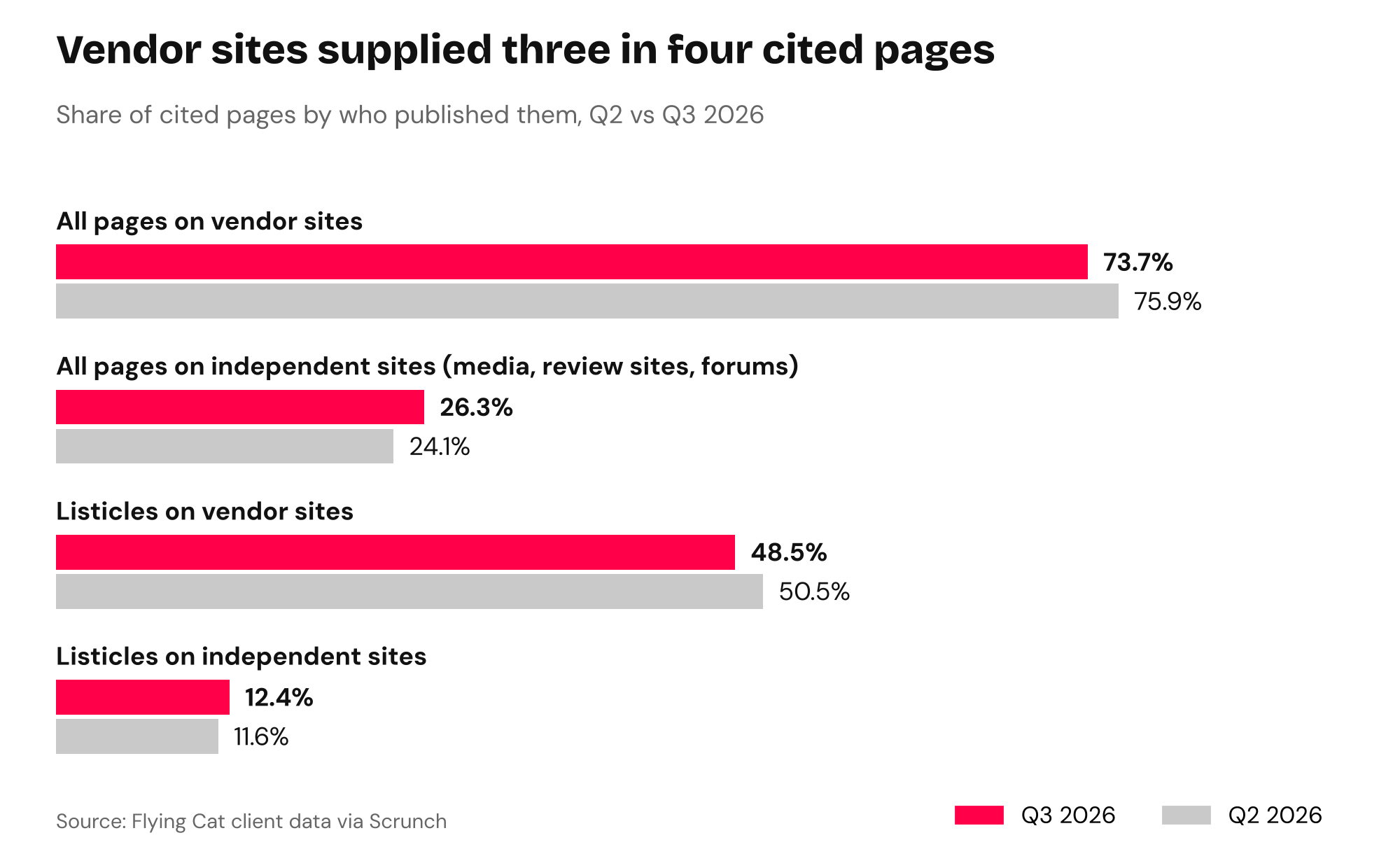
Vendor sites supplied 73.7% of cited pages, down from 75.9%. Listicles on vendor sites slipped from 50.5% to 48.5%, while listicles on independent sites rose from 11.6% to 12.4%.
The rumor, tested
The rumor says AI will cite a self-promotional listicle and leave the publisher’s name out of the answer.
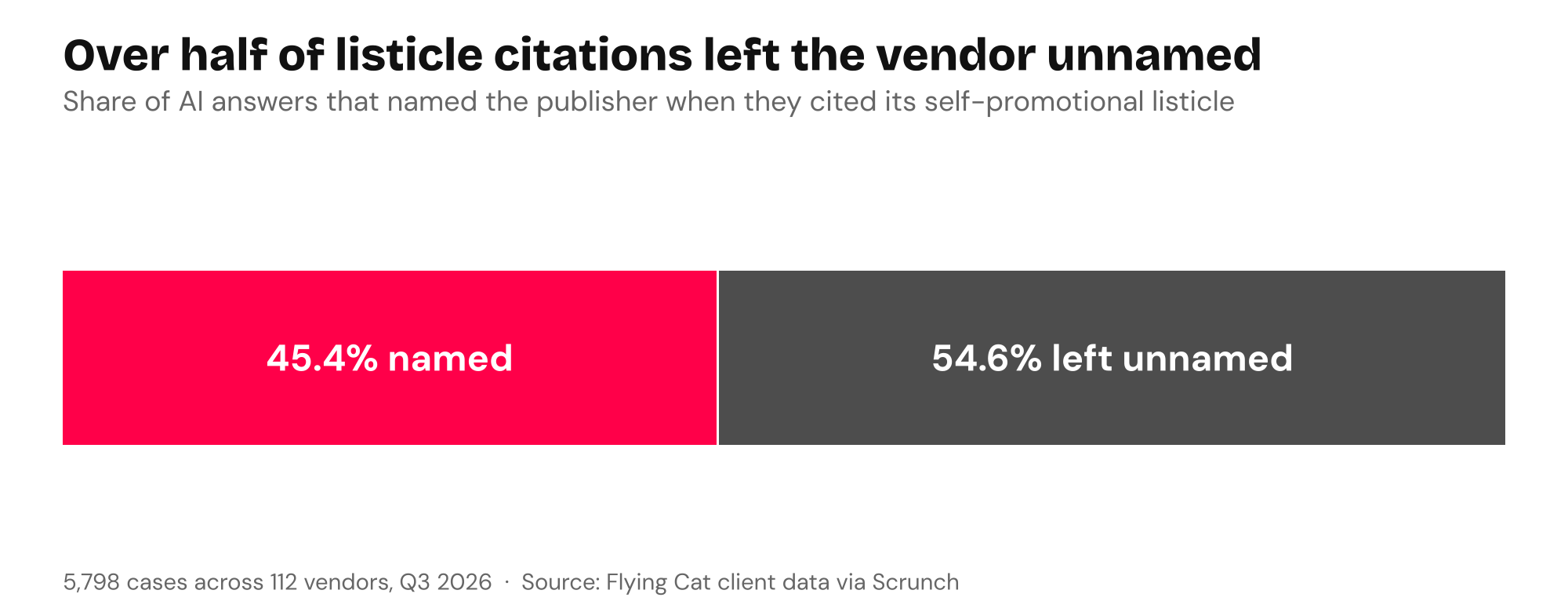
Across 5,798 cases where an AI answer cited a vendor’s own listicle, the answer named that vendor 45.4% of the time and left it unnamed 54.6% of the time. So the rumor held. Taken alone, that number misleads.
What the listicle added
I took one publisher and one question, such as “best LMS for associations”. Some AI answers to that question linked the publisher’s listicle and some left it out. I counted how often the publisher’s name appeared in each group. A big gap means the listicle earned the mention. Two matching numbers mean the brand was going to get named anyway.
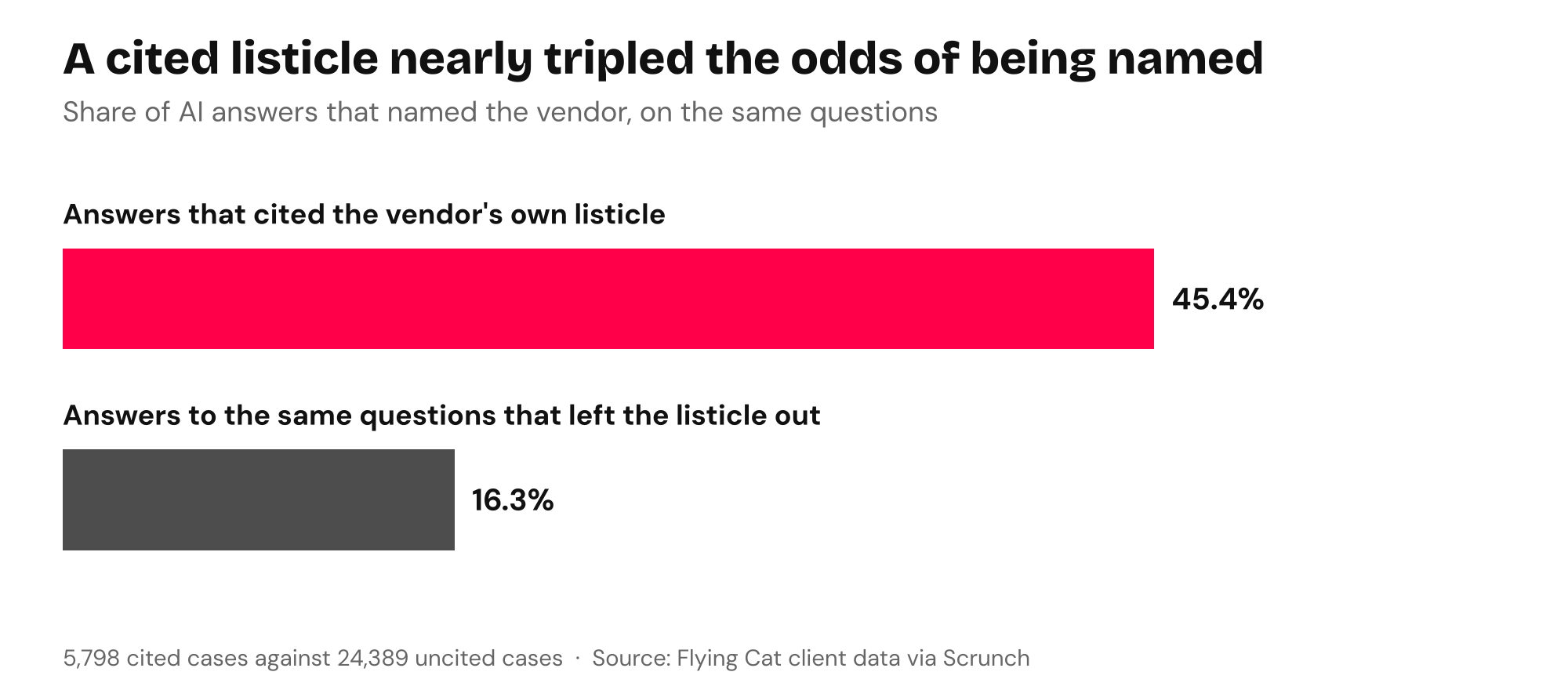
Vendors got named 45.4% of the time when their listicle was cited, against 16.3% on the same questions without it. On answers matched by question and by AI platform, the gain was 23 points.
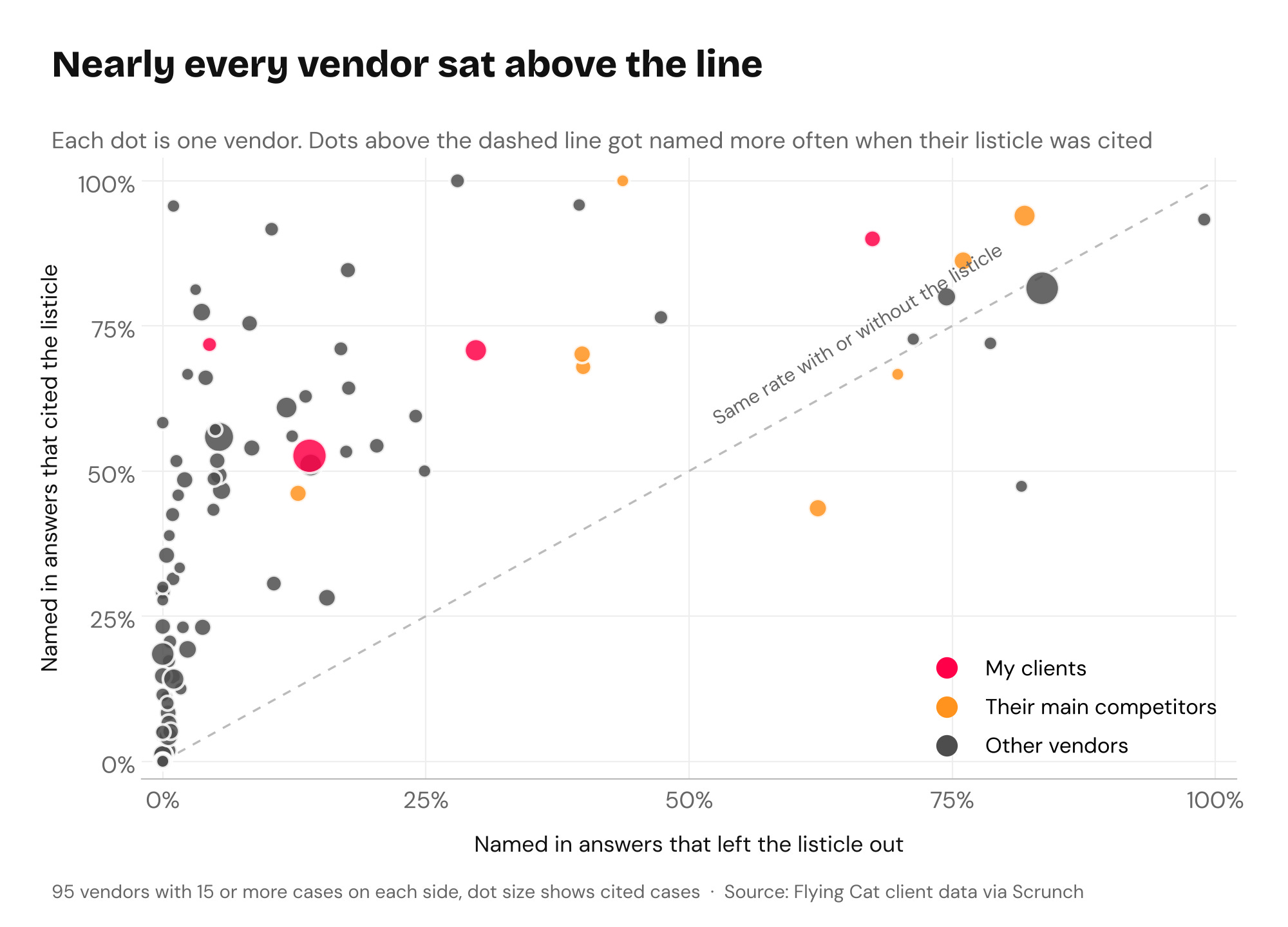
Each dot is one vendor. Of the 94 vendors with enough data to compare, 78 sat above the line.
Brand size set the starting point
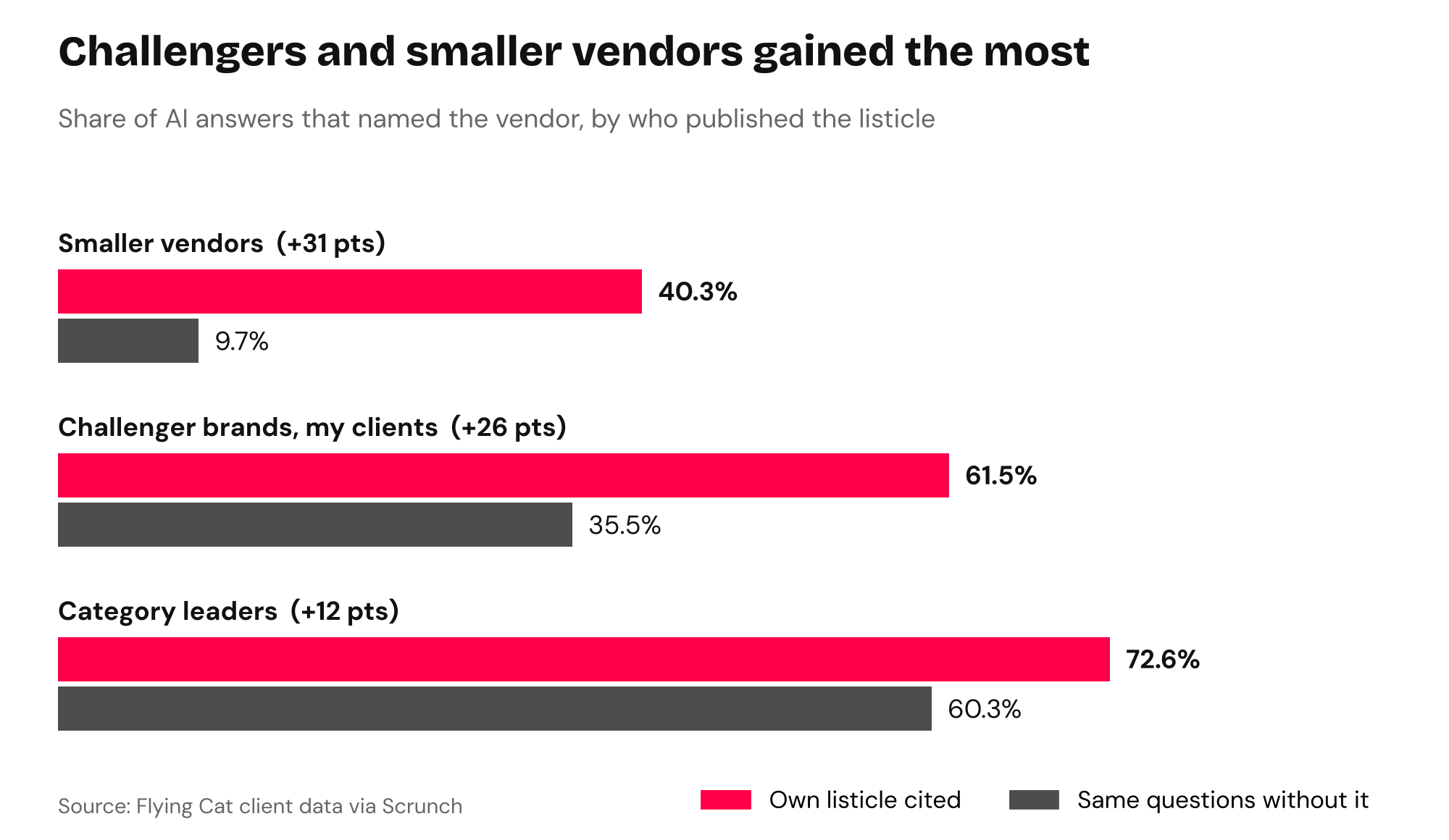
My clients are challenger brands. Their listicles took them from 35.5% to 61.5%. Category leaders started at 60.3% and reached 72.6%. Smaller vendors started at 9.7% and reached 40.3%.
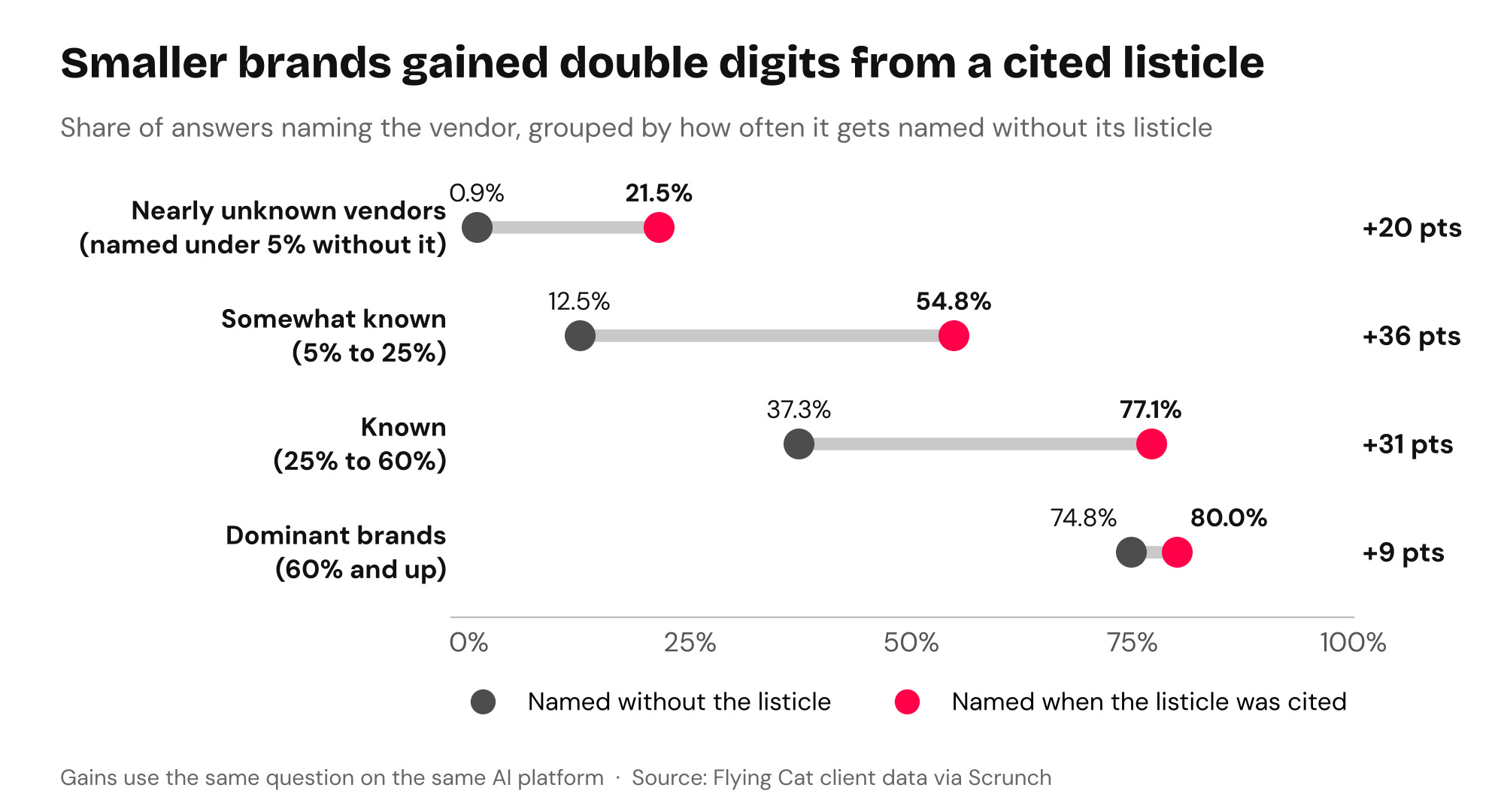
Vendors that were nearly unknown went from 0.9% to 21.5%. Somewhat known vendors went from 12.5% to 54.8%. Dominant brands moved from 74.8% to 80.0%, since AI names them either way.
Bigger brands got named more often overall. Smaller brands got named less often overall, and their listicles still lifted them by double digits.
More listicles, more citations
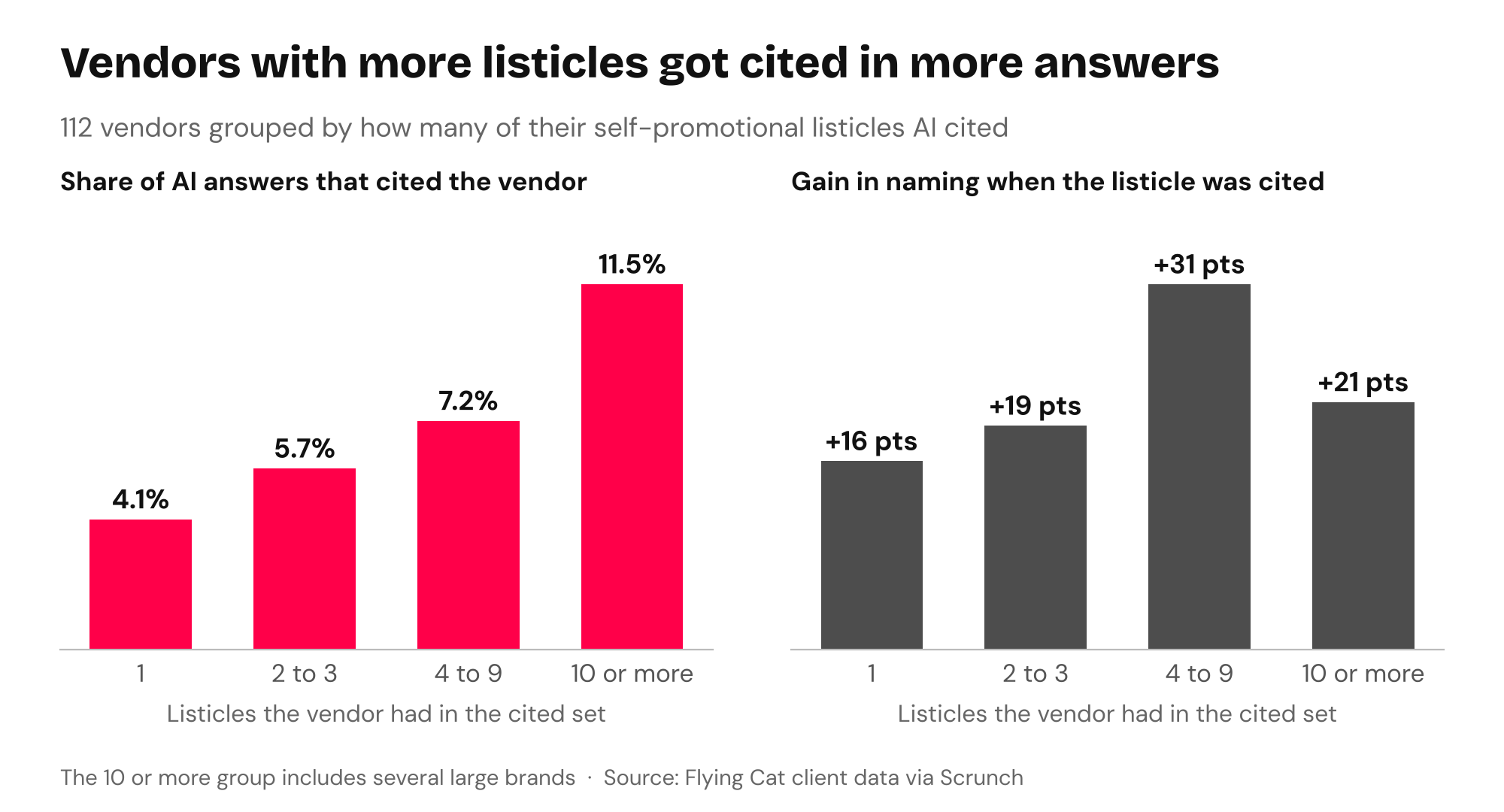
Vendors with a single listicle in the cited set showed up in 4.1% of answers. Vendors with 10 or more showed up in 11.5%. The gain in naming per citation peaked in the 4 to 9 group at 31 points. The 10 or more group includes several large brands, so brand size blurs that last bar.
It varied by AI platform
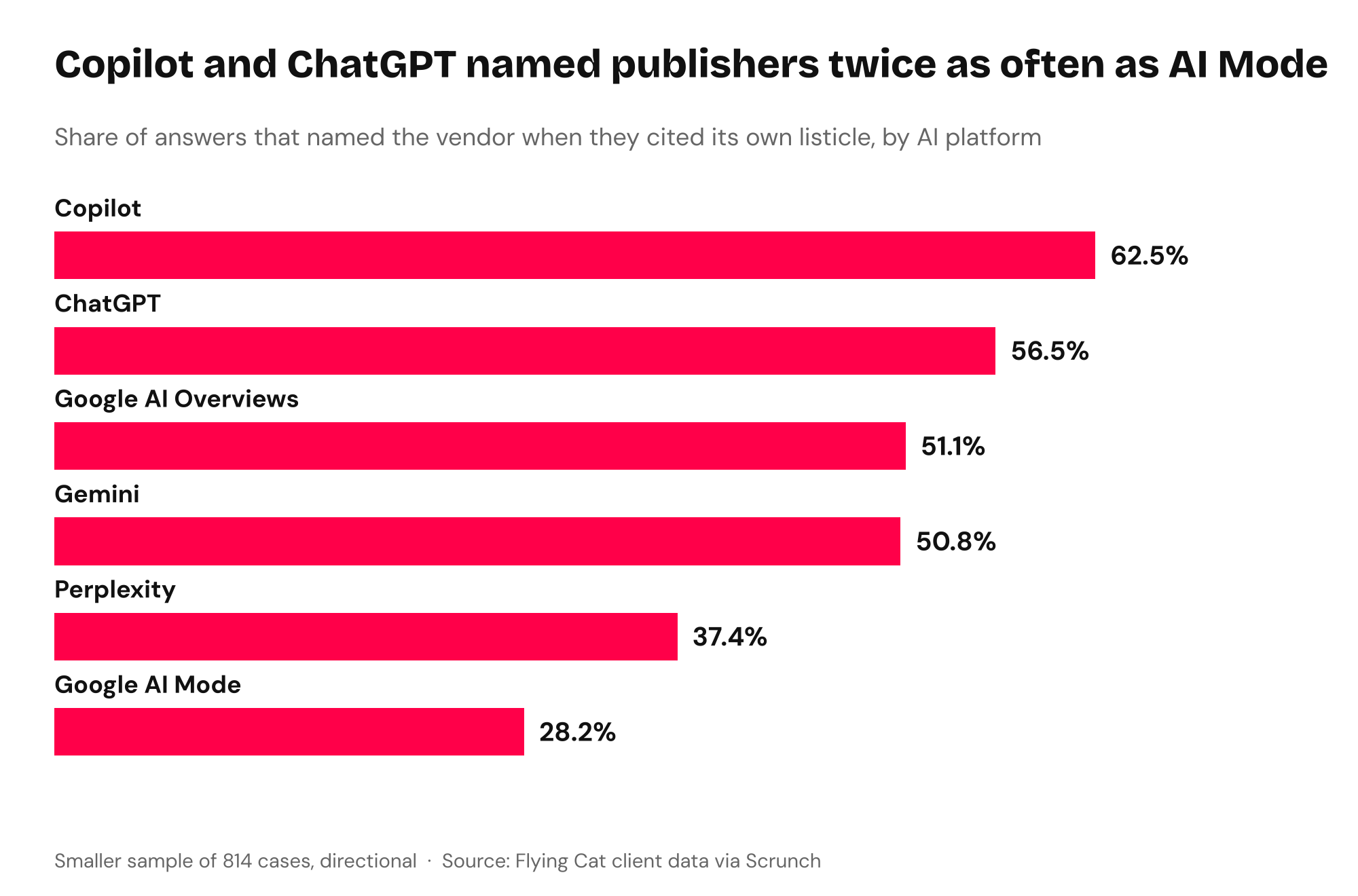
Copilot named the publisher in 62.5% of cases and ChatGPT in 56.5%. Perplexity came in at 37.4% and Google AI Mode at 28.2%. This cut comes from a smaller sample of 814 cases, so I treat it as directional.
I found zero evidence of harm
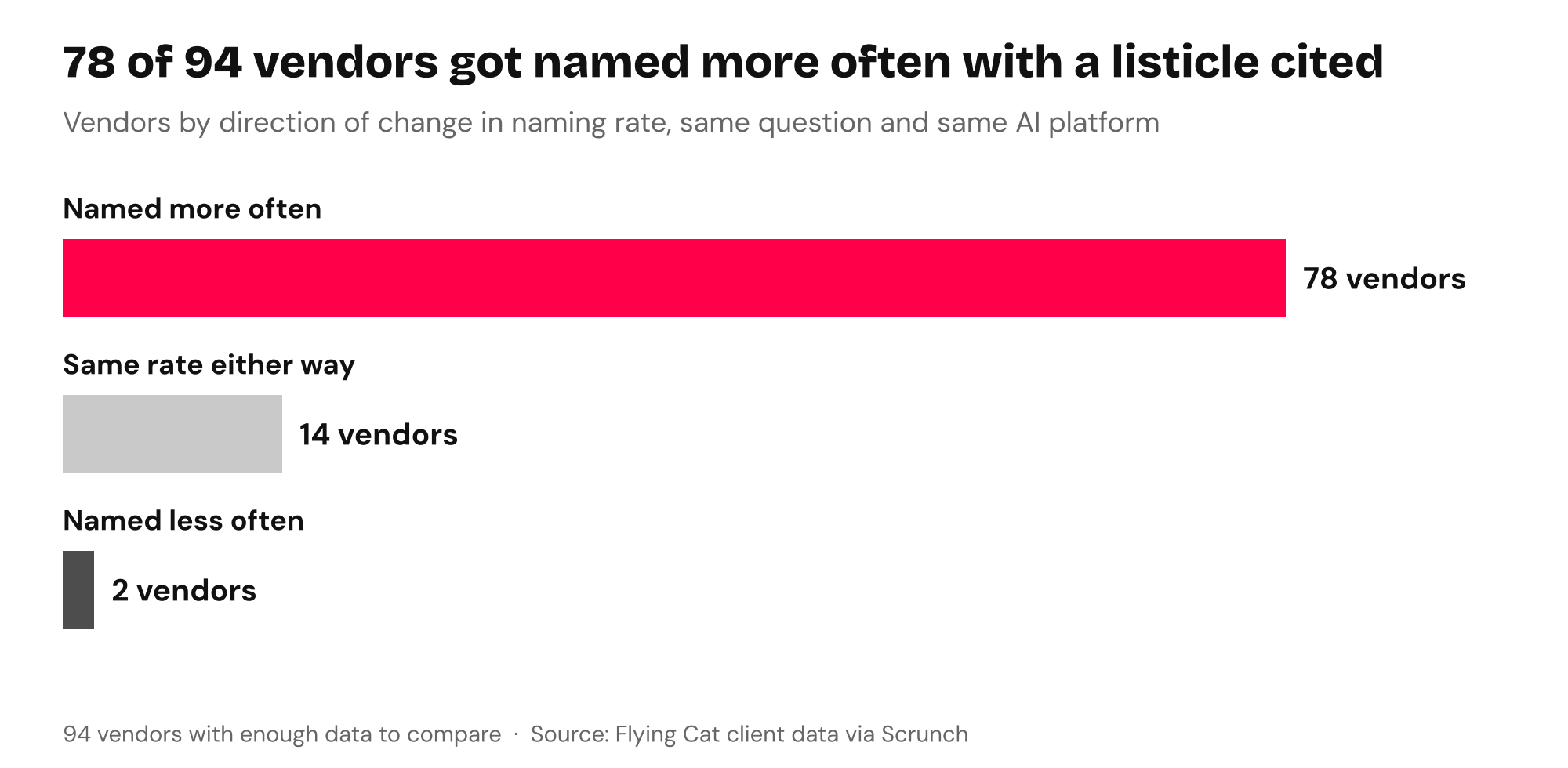
78 vendors got named more often, 14 saw the same rate either way and 2 got named less often. The 14 flat vendors went unnamed with or without a listicle. The 2 that dropped were a vendor with a single listicle and a platform that the questions were already about.
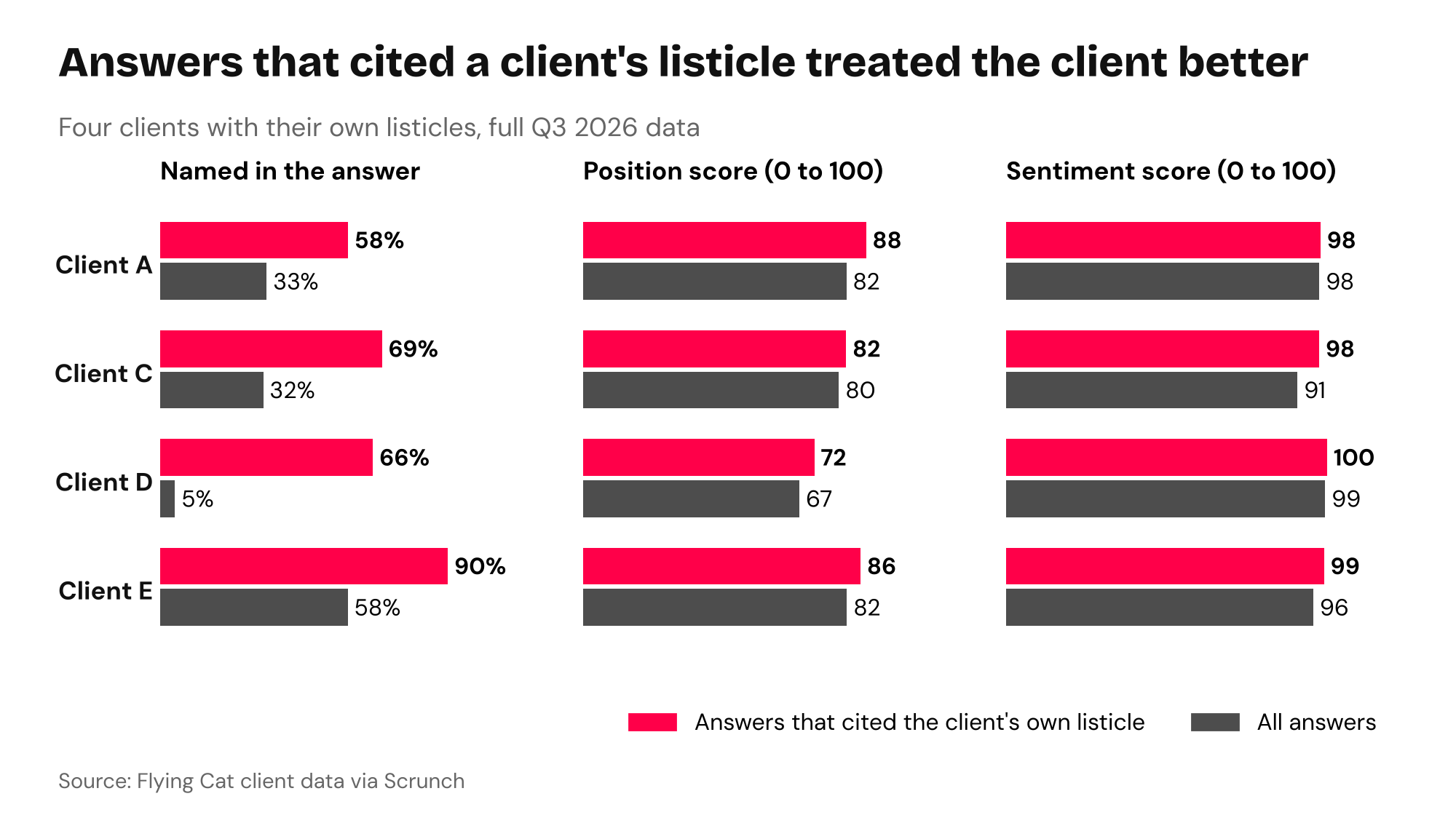
For my own clients I have the full Q3 data. Answers that cited their listicles named them more often and scored higher on position and sentiment. Client A got named in 58.5% of answers that cited its listicles, against 33.2% across all answers. Client D went from 4.6% to 66.3%.
Where the name went missing
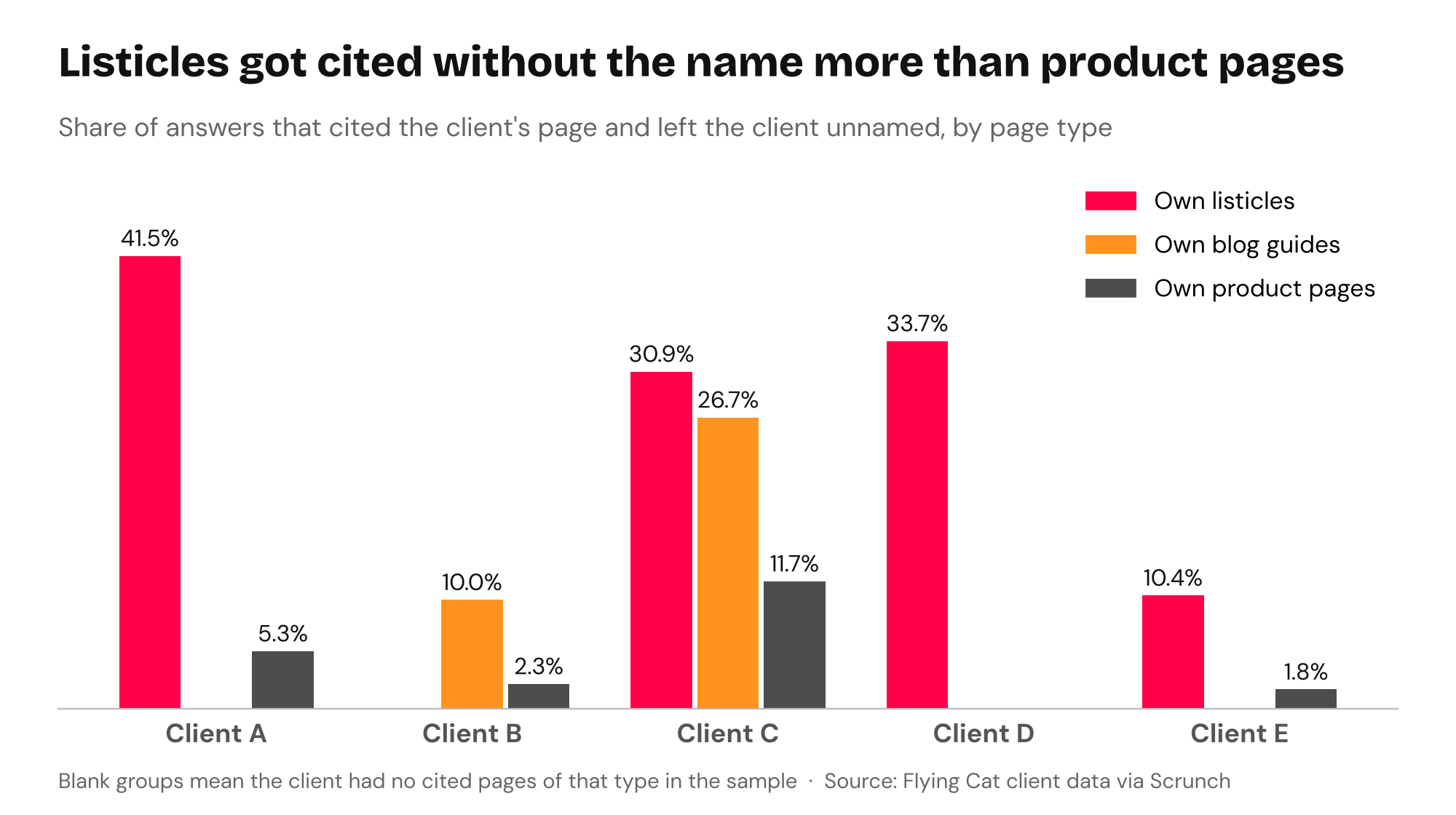
Listicles carried the highest cited-but-unnamed rate of any page type on my clients’ sites. Client A’s listicles got cited without a mention 41.5% of the time, against 5.3% for its product pages. My read is that AI uses a roundup as a source for every vendor on it, so the publisher earns the link while the answer talks about someone else.
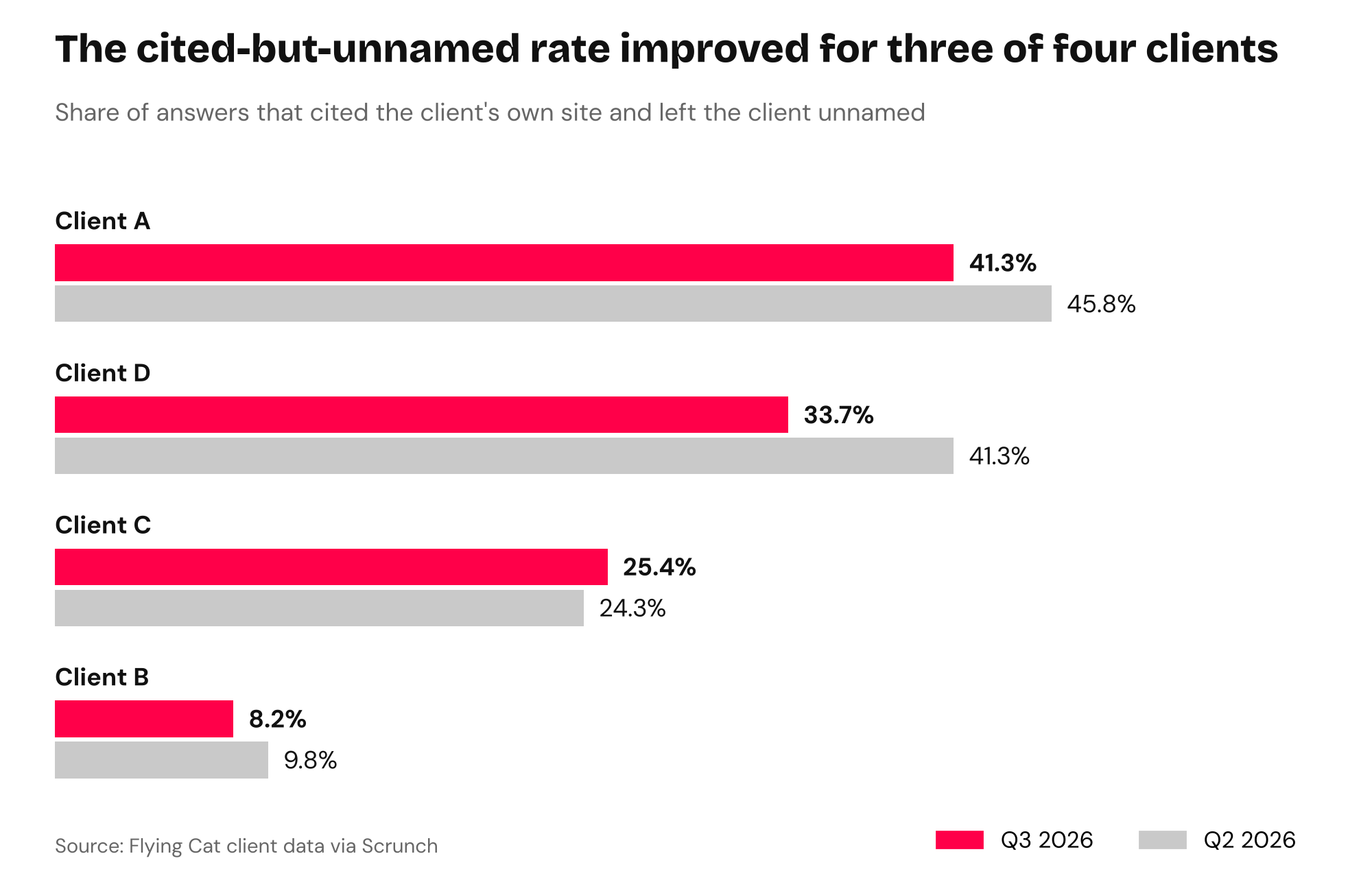
That rate improved from Q2 to Q3 for three of the four clients with two quarters of data.
What I took from it
The rumor is partially true
A citation of a self-promotional listicle left the publisher unnamed over half the time. A cited listicle also roughly tripled the share of answers that named the publisher, 45.4% against 16.3%. Across my clients that worked out to a 26-point lift. I found zero evidence of harm, and nothing in this data says to stop publishing them.
Limits
This data shows association. An AI that already planned to name a vendor may go and cite that vendor’s page, which would inflate the gain. The name check covered about 10% of Q3 answers. Vendor names outside my tracked competitor lists were matched by text search. And this is five clients, all B2B SaaS, on prompt sets that lean toward list-style questions.